
Categories
CattlePublished August 24, 2026
300,000 Metric Tons of Beef Is Coming In Tariff-Free. Here's What That Actually Means.

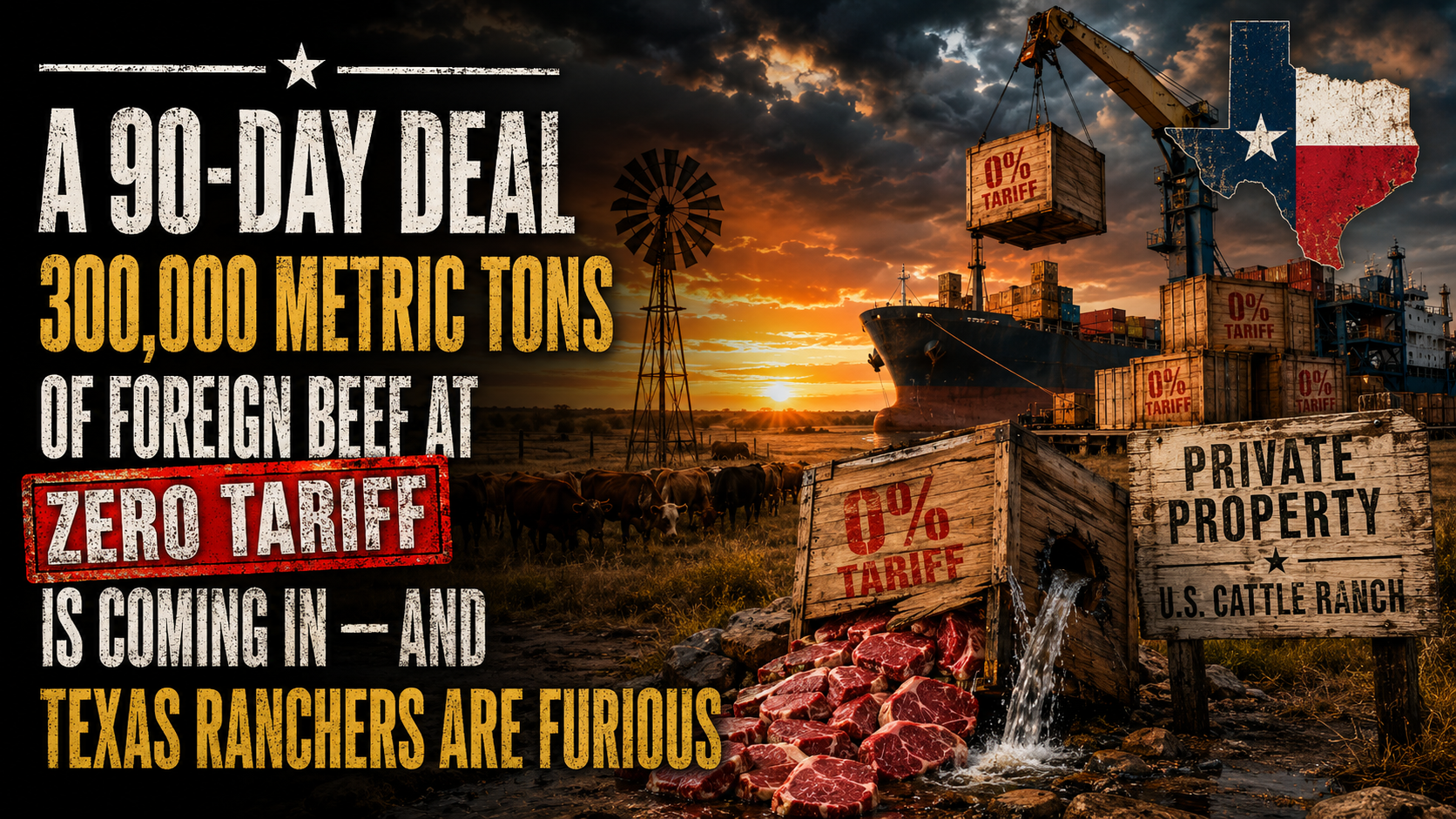
You've probably seen the headline: the U.S. is about to let in 300,000 metric tons of foreign beef with no tariff, and prices at the store are supposed to drop. That sounds simple. It isn't. Here's what's actually happening, what the number really means in day-to-day terms, and why cattle producers are pushing back hard.
What Was Announced
President Trump announced on Truth Social that the United States will allow up to 300,000 metric tons of foreign beef intended for ground beef to be imported without an out-of-quota tariff, and the tariff-rate quota lift will last 90 days. He said there's a commitment that this beef will be sold at 25% below current market prices, framing it as a way to bring down grocery costs while the American cattle herd rebuilds.
This wasn't the administration's first move on beef imports. Back in February 2026, Trump signed a separate executive order quadrupling the tariff-free import quota for Argentine beef, an order titled “Ensuring Affordable Beef for the American Consumer.” That earlier move was framed as a response to record-low U.S. cattle inventories following years of drought, wildfires, and rising feed costs.
One detail worth noting: when a reporter directly asked which countries this new 300,000-ton deal involves, Trump declined to answer. No countries. No suppliers named. Just a number and a 90-day window.
What Does 300,000 Metric Tons Actually Look Like?
Numbers like “300,000 metric tons” are easy to read past. So let's translate it into something you can picture.
300,000 metric tons works out to roughly 661 million pounds of beef. Spread evenly across the 90-day window, that's about 7.3 million pounds of tariff-free foreign beef entering the country every single day for three months straight.
For comparison, some of the largest single beef processing plants in the country — Cargill's Dodge City, Kansas plant and National Beef's Liberal, Kansas plant — each run at a capacity of around 6,000 cattle processed per day. Using typical industry yield estimates, a plant running at that capacity produces somewhere around 3 million pounds of beef a day. That means this import surge is bringing in more than double what one of the largest beef plants in America can produce in a single day — and none of it puts a dollar in a U.S. rancher's pocket.
Zoom out further and the scale gets bigger. The U.S. Cattlemen's Association put it plainly: “300,000 metric tons represents roughly half of total U.S. beef export volume so far in 2026 – a significant volume shift to absorb in a short window.” That's not a minor adjustment to supply. That's close to half a year's worth of the country's own beef exports, arriving from unnamed sources, in three months.
Another Way to Picture the Number: Days of National Supply
Here's a cleaner way to see the scale, using USDA's own figures. USDA's Economic Research Service projects 2026 per-capita beef availability at 60 pounds per person. Multiply that across the U.S. population and you get the country's total annual beef supply. 661 million pounds — the amount cleared for tariff-free import — works out to roughly 12 days worth of the entire nation's beef supply, arriving inside a single 90-day window.
That's one estimate using total beef availability. Using a narrower slice — just ground beef consumption — one cattle market analyst put the same 300,000 metric tons at roughly 44 days worth of U.S. ground beef consumption. The two numbers differ because they're measuring against different baselines, but they point at the same conclusion: this is a large, fast volume shift by any measure.
The American Farm Bureau Federation calculates that 300,000 metric tons represents nearly a 60% increase in imports over the next 90 days — arriving on top of an already record pace, with U.S. beef imports running 562,000 metric tons in the first quarter of 2026 alone, up 18% year-over-year and 122% above five years ago.
The Market Didn't Wait to React
Numbers on paper are one thing. The cattle market's response was immediate. The same Friday morning the announcement dropped, live cattle futures fell $3 to $4 per hundredweight while feeder cattle futures dropped $3 to $6 per hundredweight. Cattle futures plunged to eight- to nine-month lows before recovering some of the losses later in the session — but the week still closed at sharply lower levels.
That kind of same-day reaction is the market pricing in real uncertainty about supply — not a slow-moving policy debate, but traders repricing risk within minutes of a Truth Social post.
Why Ranchers Are Pushing Back
The cattle industry's objection isn't really about whether beef is cheap right now — it's about who pays for that discount long-term. USCA has said there's no clear evidence that increasing imports this way lowers retail prices for consumers, while there is evidence that flooding the U.S. market with foreign beef can depress the prices American producers get paid for their cattle. The group also pointed to a recent safety concern: a prior recall of beef imported from Argentina, following an earlier tariff-rate quota decision, raised questions about whether the supply chain and inspection system can keep up with rapidly rising import volumes.
Lawmakers have picked up the same argument. One Ohio congresswoman called it a “slap in the face to ranchers, producers, and farmers,” and argued the administration is undercutting American cattlemen after already paying Argentina to send more beef here.
Economists, meanwhile, are skeptical the move will even accomplish its stated goal. A food economist at Michigan State University noted that even the earlier 80,000-ton Argentina expansion represented well under 1% of the overall U.S. beef supply — too small on its own to meaningfully move consumer prices. The 300,000-ton figure is far larger, but the same basic question applies: does a temporary import surge actually lower what you pay at the register, or does it mainly shift who profits from the sale?
Why the U.S. Cattle Herd Is Stretched Thin Right Now
None of this is happening in a vacuum. U.S. cattle inventories have fallen to historic lows, sitting at 94.2 million head as of mid-2025 — the smallest herd in decades — after years of drought, high feed costs, and herd liquidation. Ground beef prices reflect that squeeze: as of this past July, ground beef averaged $6.89 per pound, up 57% over five years.
That's the tension at the center of this whole debate. The administration is trying to solve a short-term affordability problem with imports. Ranchers argue that's exactly the wrong move while the domestic herd is trying to rebuild — because cheaper imported beef can discourage the very herd expansion the administration says it wants.
What This Means If You Own or Want to Own Ranch Land
Here's why this matters beyond the grocery store. Cattle prices and land values are connected. When the price ranchers get paid for cattle comes under pressure, it changes the math on running a herd — which affects what land is worth, how buyers evaluate ranch property, and how financing decisions get made for anyone looking to get into cattle or expand an existing operation.
Policy swings like this one are exactly why it pays to have someone watching the ag and land market for you, not just the MLS. If you're evaluating ranch land in North Texas — whether you're planning to run cattle or just want land that holds its value — this is the kind of shift that should factor into your timing and your financing strategy.
Have questions about how this could affect land or cattle values in Parker, Palo Pinto, Erath, Wise, Hood, or Jack County? Send me a message. I'll walk you through it.
Sources
● Oklahoma Farm Report — “Trump Announces 90-Day Tariff-Free Beef Import Plan, Triggering Cattle Futures Drop”
● The Bullet — “Beef Backlash: Trump's 90-Day Import Plan Sparks Outcry Across US Cattle Industry”
● AgWeb / Drovers — “Trump Announces Deal to Slash Ground Beef Prices by 25%, Sends Markets Lower”
● Ag Bull Trading — “Trump's 300,000-Tonne Beef Play: Big Politics, Smaller Beef Impact”
● USDA Economic Research Service — per-capita beef availability projections, 2026
● DTN Progressive Farmer — “Trump Proposes Lifting Tariff Rate Quota on 300,000 Metric Tons of Beef Imports”
● CBS News — “Trump temporarily waives higher beef tariffs in bid to lower prices”
● CBS News — “Trump signs executive order quadrupling beef imports from Argentina”
● CBS News — “More Argentina beef imports won't do much to ease costs for consumers, according to experts”
● Yahoo News — “Mystery Meat: Trump Refuses to Say Where His New Flood of Foreign Beef Is Coming From”
● Roll Call — “Trump creates beef with ranchers over new import plan”
● AGDAILY — “Trump expands Argentine beef imports amid U.S. cattle shortage”
● Beef Magazine — “Cattle groups react to Trump's beef import post”
● Oklahoma Farm Report — “Ag Groups React to Trump's Beef Tariff Announcement”
● U.S. Cattlemen's Association — official statement, uscattlemen.org
● Wikipedia — “Golden Triangle of Meat-packing” (plant capacity data)
● High Country News — “The Big Four Meatpackers” (national slaughter/production data)

Greg Potts
| Greg Potts | GS Realty Team | Fathom Realty
or another way