
Categories
Ag ExemptionPublished August 29, 2026
AG Exemption- You don't always need cattle to qualify.

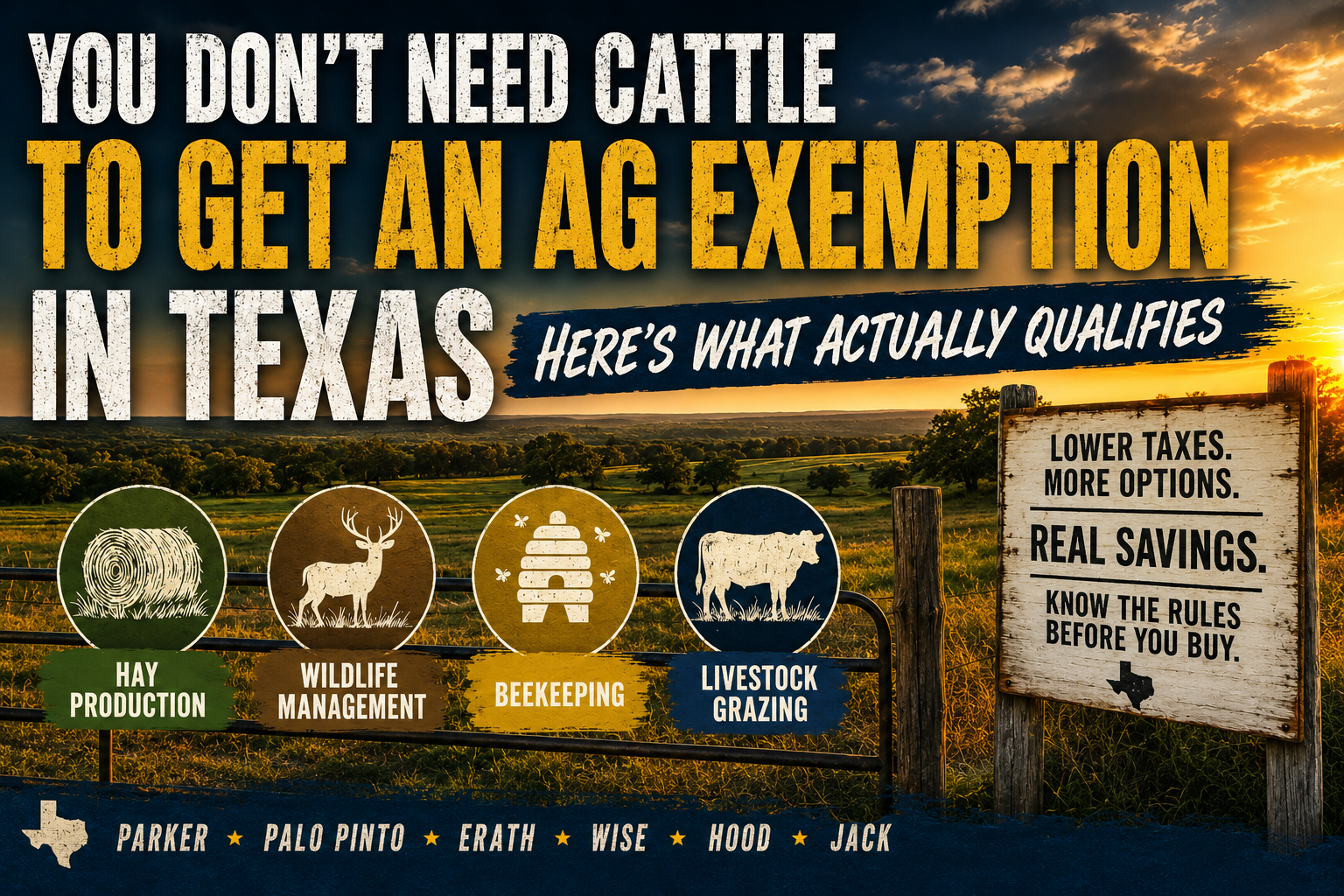
You Don't Need Cattle to Get an Ag Exemption in Texas — Here's What Actually Qualifies
If you're shopping for land in North Texas, you've probably heard the term "ag exemption" thrown around — usually followed by someone assuming it means running cattle. It doesn't. And the rules for getting one are more complicated, and more flexible, than most buyers realize.
Ag Exemption Rules Change by County
Texas doesn't have one statewide standard for agricultural exemptions. Each county appraisal district sets its own minimum acreage and requirements, and those numbers can vary significantly. A tract that qualifies for ag valuation in Parker County might fall short of the requirement in Palo Pinto County. Wise, Hood, Erath, and Jack counties each have their own thresholds too.
This matters because the ag exemption isn't really an "exemption" in the traditional sense — it's a special valuation. Instead of your land being taxed on its market value, it's taxed on its agricultural productivity value, which is almost always lower. On a large tract, that difference can mean thousands of dollars a year in property taxes.
You Don't Have to Run Cattle
This is the part that surprises most buyers: cattle are just one path to qualifying, not the only one. Depending on the county and the land itself, you may be able to qualify through:
- Hay production — cutting and selling hay off the property
- Wildlife management — an increasingly popular option that lets landowners maintain habitat instead of livestock, often used as a transition when a family scales back a working operation
- Beekeeping — yes, bees count. Texas law allows agricultural valuation for land used to raise honeybees, with its own acreage rules
-
Traditional livestock grazing — cattle, but also other livestock depending on the county
Each of these comes with its own documentation requirements, minimum acreage, and timelines. Some counties require a history of agricultural use before you can apply; others allow a newer landowner to establish it going forward.
Why This Trips Up Buyers
The most common mistake is assuming the exemption automatically transfers with the sale, or that whatever qualified for the previous owner will qualify for you. Neither is guaranteed. A change in ownership can trigger a reassessment, and if the new use doesn't meet that specific county's requirements, the exemption can be lost — sometimes with a rollback tax bill covering the previous five years.
The second mistake is buyers ruling out land entirely because they don't want to run cattle, not realizing hay, wildlife, or bees might get them there instead.
Why This Is Where an Agent Earns Their Keep
This is exactly the kind of detail that separates an agent who sells ranch land for a living from one who occasionally lists a rural property. Knowing the acreage minimums and accepted ag uses for Parker, Palo Pinto, Erath, Wise, Hood, and Jack counties — and knowing which appraisal district to call before you write an offer — can save a buyer real money and real headaches down the road.
If you're looking at land and aren't sure whether it'll qualify, or what use makes the most sense for your goals, that's a conversation worth having before you're under contract, not after.
I'm Greg Potts with GS Realty Team. We know this ground. Let's find yours.

Greg Potts
| Greg Potts | GS Realty Team | Fathom Realty
or another way