
Categories
WaterPublished September 13, 2026
How much land do you need to drill a water well in North Texas? It Depends…
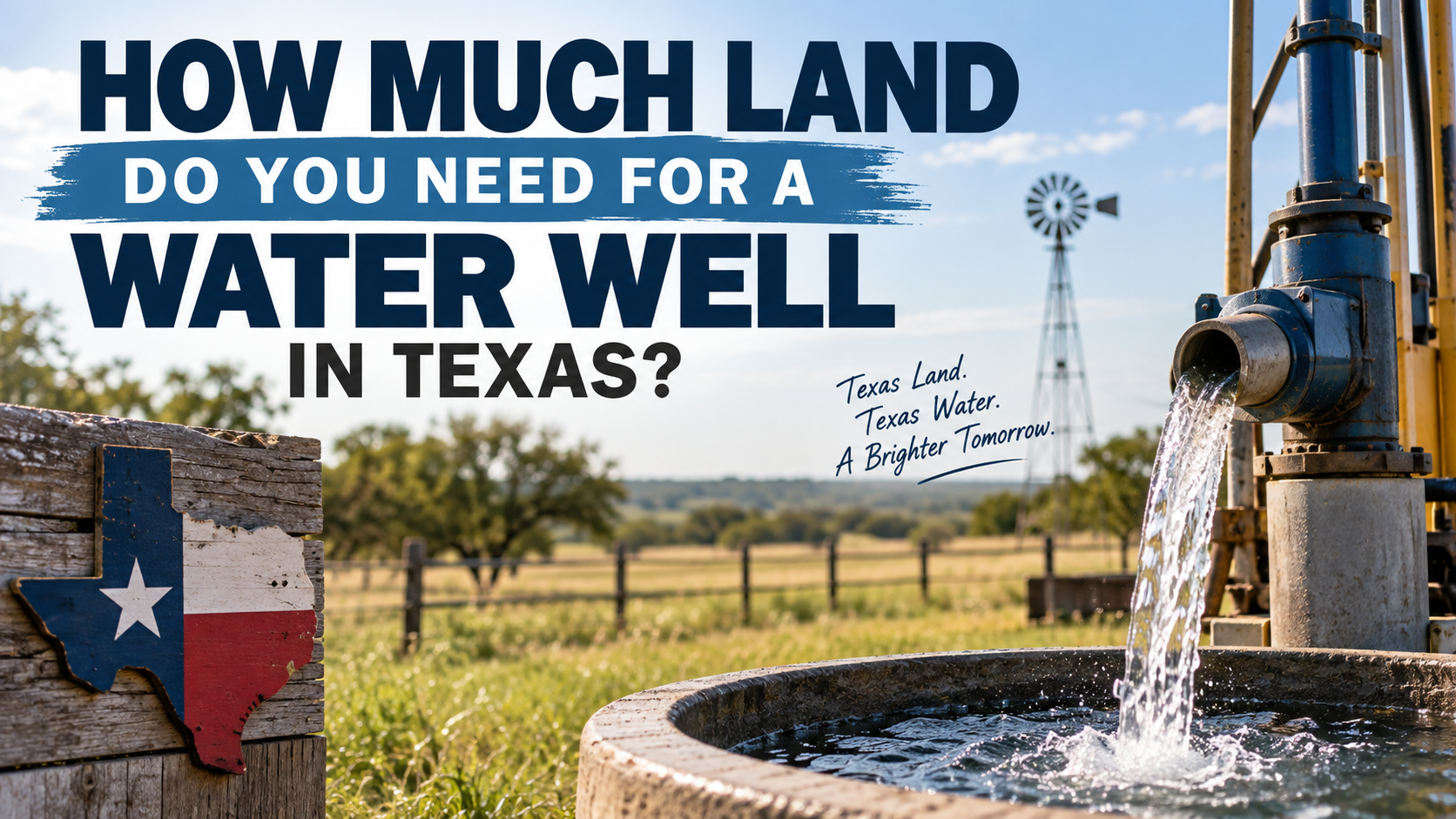
How Much Land Do You Need for a Water Well? Depends Which County You're In
I get this question all the time from buyers: "How many acres do I need to put in my own well?" The honest answer is — it depends entirely on which county the property sits in. Here's the breakdown across the counties we work in every day.
The 2-Acre Counties: Most of Parker, Hood, Wise, and Erath
Parker, Hood, and Wise County fall under the Upper Trinity Groundwater Conservation District (UTGCD). Its rules set a minimum tract size of 2 acres for wells producing 17.36 gallons per minute or less — which covers the vast majority of domestic and ranch wells — along with 150 feet of spacing from other wells and 50 feet from property lines (Upper Trinity GCD Rules). Montague County falls under the same district and the same baseline rule.
Erath County lands in the same 2-acre range, but under a different district. The Middle Trinity Groundwater Conservation District, which also covers Bosque, Comanche, and Coryell counties, sets a minimum of 2 acres for a tract with a private well and septic system (Middle Trinity GCD).
The Exception: Western Wise AND Western Parker Are Going to 5 Acres
Two pockets are breaking from the rest of the district, and both share the same thin stretch of aquifer. Western Wise County — generally Precincts 2 and 4, around Alvord, Chico, Paradise, Bridgeport, and Runaway Bay — is raising its minimum tract size for a new well from 2 acres to 5, starting January 1, 2027 (Wise County Messenger; Hoodline). Western Parker County is making the identical move on the identical date — also 2 acres to 5, effective January 1, 2027.
The reason is geology, not paperwork. The Trinity Aquifer's freshwater layer across this stretch of western Wise and western Parker runs only about 60 feet thick, against a roughly 600-foot average across North Texas — and the area already carries some of the heaviest well density in the state. Parker County alone has processed 500 to 600 new well applications a year for over a decade, according to UTGCD General Manager Doug Shaw (Weatherford Democrat). Wells in the affected areas have already started going dry. Properties already platted, or with a well application filed before the end of 2026, are grandfathered under the old 2-acre rule in both counties.
No District at All: Palo Pinto and Jack Counties
Palo Pinto and Jack counties are a different story entirely — neither has a groundwater conservation district. With no district, there's no acreage minimum on the books for a private well; drillers still follow the state's general well-spacing standards, but no local rule sets a minimum tract size the way UTGCD or Middle Trinity does.
That's not guaranteed to last. Jack County has been publicly debating whether to join an existing district or form its own, largely driven by concern over data centers moving into the county and drawing heavily on groundwater without any local oversight in place.
What This Means If You're Buying, Selling, or Subdividing
- The same size tract can mean two different things depending on the county line. A 2- or 3-acre property that could have its own well in Palo Pinto or Jack County might not qualify in western Wise or western Parker County after 2027.
- Timing matters in both western Wise and western Parker. Getting a property platted or a well application filed before December 31, 2026, locks in the old 2-acre rule in either county.
- "No district" is a current condition, not a permanent one. If you're buying land in Palo Pinto or Jack County specifically because there's no acreage restriction today, it's worth knowing that could change — Jack County is already having that conversation.
- An existing well on a small tract is a real asset. Anywhere the minimum acreage has gone up or could go up, a property that already has a working well on a smaller footprint is harder to replicate for the next buyer.
The Bottom Line
| County |
Groundwater District |
Minimum Acreage for a New Well |
|---|---|---|
| Parker (most of county) |
Upper Trinity GCD |
2 acres |
| Parker (western) |
Upper Trinity GCD |
5 acres starting Jan. 1, 2027 |
| Hood |
Upper Trinity GCD |
2 acres |
| Wise (most of county) |
Upper Trinity GCD |
2 acres |
| Wise (western, Precincts 2 & 4) |
Upper Trinity GCD |
5 acres starting Jan. 1, 2027 |
| Erath |
Middle Trinity GCD |
2 acres |
| Palo Pinto |
None |
No district minimum |
| Jack |
None (may change) |
No district minimum |
If you're not sure how a specific property fits into this picture, that's exactly the kind of question worth asking before you write an offer — or list.
Sources:
- Upper Trinity Groundwater Conservation District — District Rules
- Middle Trinity Groundwater Conservation District — Subdivision Regulations
- Wise County Messenger — 5-Acre Minimum Lots Required for New Wells in West Wise Starting in 2027
- Hoodline — Western Wise County Well Rules Tighten as Thin Aquifer Forces 5-Acre Minimum
- Weatherford Democrat — County Tops State in Number of Wells Drilled
GS REALTY TEAM | Fathom Realty I'm Greg Potts with GS Realty Team. We know this ground. Let's find yours.
Newsletter Signup: https://mailchi.mp/gsrealtyteam/the-land-life | Search Properties: https://bit.ly/4xnhwls | Connect with us: https://bit.ly/4c2TLX9 | What's Your Property Worth?: https://bit.ly/4c5C7Cb
Greg Potts
| Greg Potts | GS Realty Team | Fathom Realty
or another way