
Categories
Ag Exemption, Buyer ResourcesPublished September 1, 2026
Ranch Fragmentation & Ag Exemption

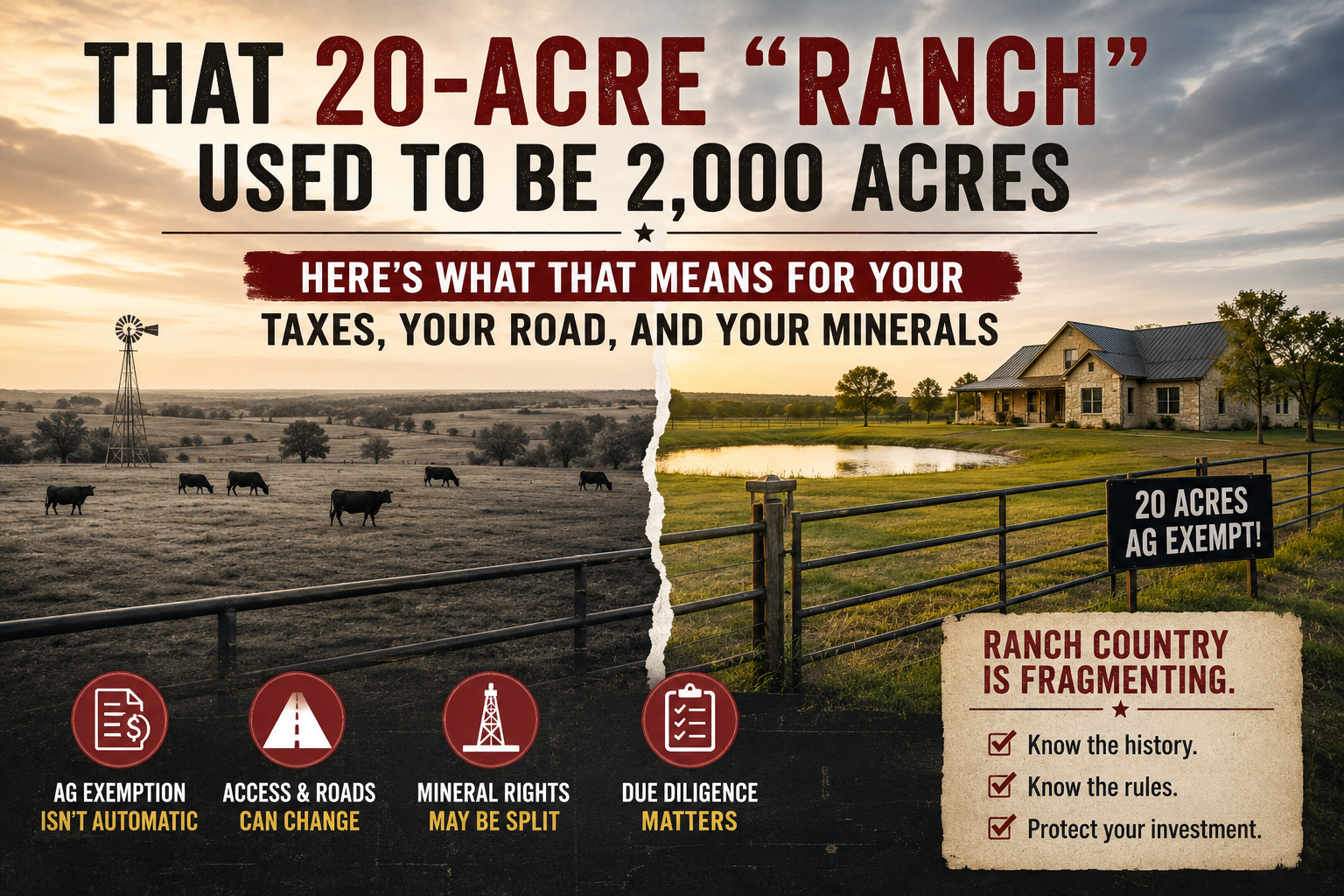
That 20-Acre "Ranch" Used to Be 2,000 Acres — Here's What That Means for Your Taxes, Your Road, and Your Minerals
That pretty little 20-acre place you've been eyeing outside Weatherford? The one with the pipe fence, the pond, and the "ag exempt!" line in the listing?
Odds are good it used to be part of something a whole lot bigger. And that changes more than you'd think.
Texas is losing its big working ranches, and it's happening fastest right here in North Texas. Texas A&M's Natural Resources Institute just updated its Texas Land Trends Fragmentation Risk Index, and the numbers are hard to ignore. Between 2017 and 2022, Texas converted more than 1.8 million acres of working land and lost more than 17,000 farm and ranch operations. The number of counties in the highest-risk category jumped from 41 to 56.
Here's the part that hits home: Parker County scored a perfect 5 — the highest possible fragmentation risk score in the state. Collin and Denton did too. And Hood County just moved into the highest-risk class alongside Kendall, Kerr, and Gillespie in the Hill Country.
If you're buying land in Parker, Hood, Palo Pinto, Erath, Wise, or Jack County, you're buying in ranch country that's actively being carved up. That's not a reason to stay away. It's a reason to know what you're looking at.
Why the Big Ranches Are Breaking Up
The Texas Land Trends index looks at four things: average farm size, change in land value per acre, how many producers are 65 or older, and projected population growth out to 2060. Where all four line up, ranches break apart.
Right now, all four are lined up around Fort Worth.
Aging operators. A lot of the folks who built these ranches are in their 70s and 80s. When Dad passes and three kids inherit 1,500 acres, one wants to keep ranching, one wants cash, and one lives in Denver. The math usually ends with a surveyor.
Land values. Change in market value per acre was the single most consistent risk factor across the whole state — 145 of 254 counties hit the maximum score on that one indicator. When the land is worth more sold in pieces than it earns running cows, families sell in pieces.
Sprawl. The Metroplex keeps pushing west. Willow Park becomes Weatherford, Weatherford becomes Millsap, and Millsap starts looking at Mineral Wells. Every mile that line moves, a ranch turns into a subdivision.
Shrinking operations. Smaller average tract size means it takes fewer transactions to fragment a county. The dominoes are already closer together.
None of this is evil. It's just economics and time. But it produces a specific kind of property — the fragmented tract — and buying one is a different game than buying a house in town or buying an intact ranch.
The Ag Exemption Problem Nobody Mentions
Let's get the technical part right first, because it matters.
There is no such thing as a Texas "ag exemption." What you actually have is an agricultural appraisal, usually under Section 1-d-1 of the Texas Tax Code, called "open-space valuation." Your land gets taxed on its productive ag value instead of its market value. On a tract in Parker County, that can be the difference between a few hundred dollars a year and several thousand. Everybody calls it an ag exemption. Fine. Just know it's a valuation, and valuations have rules.
Here's the rule that bites people when a ranch gets split up: ag valuation does not automatically transfer to a new owner, and it does not automatically carry over to a subdivided tract.
When a 2,000-acre ranch is cut into ten 200-acre tracts, or a 200-acre tract is cut into ten 20-acre lots, each new piece has to qualify on its own. That means:
You have to reapply. A new owner must file an application with the county appraisal district, generally by April 30 of the year you want the valuation. Miss it, and you can be looking at a full market-value tax bill that first year.
The tract has to meet the county's minimum standards. Every appraisal district sets its own "degree of intensity" requirements — how many head of cattle per acre, how many acres of hay, how many beehives, and so on. Many districts also have practical minimum acreages. A 20-acre tract that was part of a working ranch might not support enough animal units to qualify on its own. The 2,000-acre operation qualified easily. Your slice of it might not.
The land has to have a qualifying history. The general rule is that land must have been in agricultural use at the accepted intensity for five of the preceding seven years. Land that's been part of a working ranch usually has that history. But if the seller stopped running cattle two years ago while the property sat on the market, you may be starting over.
The neighbors matter now. On an intact ranch, one owner made one decision about grazing. On a fragmented tract, ten owners make ten decisions. If your 20 acres is too small to graze on its own and your neighbor won't lease you his, you don't have an ag operation. You have a big yard with a big tax bill.
And then there's the rollback tax. If land loses its ag valuation because the use changes — say a buyer decides to build a house and fence out the cattle — the appraisal district can claw back the difference between ag-value taxes and market-value taxes for the previous three years, plus interest. On a tract where the market value is many times the ag value, that's a check nobody enjoys writing. Make sure you know who's on the hook for it in your contract.
Wildlife management is the escape hatch a lot of buyers reach for — managing for native species instead of running livestock. It's a real option, but it has its own catch: the land has to already qualify under 1-d-1, and when a tract has been subdivided, most counties enforce a minimum tract size for wildlife use. A 20-acre lot cut from a bigger ranch often doesn't make the cut.
Bottom line: the "ag exempt" line in the listing tells you what the seller's taxes were. It does not tell you what yours will be.
It's Not Just Taxes: Roads, Easements, and the Gate That Isn't Yours
When one family owns 2,000 acres, they don't write anything down. The ranch road is just the ranch road. The gate is just the gate. The water line from the well to the pens has been there since 1974 and nobody has a map of it.
Then the ranch gets cut into ten pieces, and every one of those unwritten arrangements becomes a legal question.
Access. That road you drove in on may cross three other tracts before it reaches yours. Is there a recorded easement? Is it a shared-maintenance easement, or is it an old handshake between brothers who no longer speak? Texas courts do recognize some unwritten easements — by necessity, by prior use — but proving one takes a lawsuit, and lawsuits cost more than the property.
Landlocked tracts. It sounds crazy, but interior tracts on a fragmented ranch can end up with no legal access at all. The family never needed a recorded easement because it was all one place. The lender needed one, though, and so will you.
Utilities and water lines. That well on the tract next door that's been feeding your stock tank for thirty years? Find out whose well it is, whose line it is, and whether you have any right to keep using it.
Fences. Texas fence law is its own rabbit hole, but the short version is: the fence line and the survey line are frequently not the same line. On a ranch that was surveyed once in 1952 and re-cut last year, expect surprises.
Minerals and Water: The Rights That Left Before the Ranch Did
This is the one that really stings.
In Texas, the mineral estate can be severed from the surface. Once it's severed, it stays severed. And on a lot of old ranches in Parker, Palo Pinto, and Jack counties — Barnett Shale country — the minerals were sold, leased, or reserved decades ago. When Grandpa sold the ranch, or when the heirs divided it, somebody reserved the minerals. Sometimes half. Sometimes all of it.
Here's what that means for you as a surface buyer: the mineral estate is dominant. The owner of the minerals, or their lessee, has the right to use a reasonable amount of your surface to get to their minerals. Roads, pads, pipelines. You can negotiate surface-use agreements, and there are protections, but if you assumed you were buying "everything," you weren't.
Water is its own animal. Groundwater in Texas belongs to the surface owner under the rule of capture, but it can be severed and sold just like minerals, and in some water-stressed counties, it has been. Surface water — creeks, rivers — belongs to the state, and using it beyond household and livestock needs takes a permit. If the listing says "creek frontage" and you're picturing irrigation, ask questions.
The frustrating part? You usually don't discover any of this until after you've fallen for the property. The pond looked perfect. The barn was exactly what you wanted. Then the title commitment comes back with a mineral reservation from 1961, and you're deciding whether you can live with a pumpjack in the horse pasture.
What to Check Before You Make an Offer on a Fragmented Tract
Buying rural land is nothing like buying a house in town. The inspection isn't a guy with a flashlight looking at the water heater. It's paper, history, and boots on the ground. Here's the short list.
1. Pull the current ag valuation and the county's intensity standards. Call the appraisal district. Ask what this specific tract needs to qualify on its own. Don't take the listing's word for it.
2. Ask when the ag use last happened, and by whom. Was the seller running his own cattle, or leasing to a neighbor who may not renew? What's the five-of-seven history?
3. Get the rollback question answered in writing. Who pays if the valuation is lost at closing or in the first year? This belongs in the contract.
4. Read the survey. The whole thing. Look for every easement, every encroachment, every gap between fence and boundary. If the survey is older than the subdivision, get a new one.
5. Trace the access. From the county road to your front gate, every foot should be either your land or a recorded easement. If there's a gap, that's a deal point, not a detail.
6. Pull the mineral history. A title commitment will show reservations, but a proper mineral run will tell you what's actually been severed, leased, and by whom. In Barnett Shale counties, assume something's been severed until proven otherwise.
7. Ask about water — both kinds. Who owns the well? Has groundwater ever been reserved? Is there a groundwater conservation district with its own rules?
8. Talk to the neighbors. On a fragmented ranch, your neighbors were all one family a few years ago. They know where the bodies are buried. Sometimes literally.
The Good News
None of this means you shouldn't buy a piece of a broken-up ranch. Some of the best properties in North Texas came from exactly that — a well-run operation that got divided carefully, with clean easements, honest surveys, and minerals that were never severed. Those tracts are out there.
And frankly, a buyer who knows how to ask these questions has an edge. Half the people looking at the same listing are picturing the sunset and the horses. You're reading the survey. When you make an offer, you know what you're paying for, and you know what you're not.
The Texas Land Trends map tells us the big ranches around Fort Worth are going to keep breaking up. That's the trend. The question is whether you buy your piece of it with your eyes open.
Want the Full Checklist?
I'm putting together a downloadable Texas Land Buyer's Checklist covering ag valuation, easements, and mineral and water rights on fragmented tracts — everything above, in a format you can take to the appraisal district and the title company.
It'll go out first to subscribers of The Land Life, our newsletter on North Texas ranch land, horse properties, and what's actually happening in this market. It's free, and it's the best place to get this kind of breakdown before it hits social media.
[Subscribe to The Land Life →] https://mailchi.mp/gsrealtyteam/the-land-life
And if you're buying or selling ranch land in Parker, Palo Pinto, Erath, Wise, Hood, or Jack County, this is what I do every day. I've sold over 50,000 acres in Texas and Oklahoma, and I run cattle and rope on my own place, so I've been on both sides of every question in this post.
I'm Greg Potts with GS Realty Team. We know this ground. Let's find yours.
817-694-1339 | gsrealtyteam.com
Greg Potts
| Greg Potts | GS Realty Team | Fathom Realty
or another way