Published July 31, 2026
Ranch Land as a Legacy Asset
Ranch Land as a Legacy Asset
Why families are trading stock portfolios for Texas and Oklahoma ground
A South Florida news outlet recently told its wealthiest readers to do something that would have sounded strange a decade ago: stop buying stocks, start buying ranches. It's not an isolated idea. The Wall Street Journal has been tracking a trend nicknamed “landmaxxing” — ultra-wealthy buyers assembling adjacent parcels into private compounds, a practice that reportedly drove a meaningful share of the ultra-luxury real estate market this year, according to The Real Deal. Citadel's Ken Griffin has spent more than $1 billion piecing together property from Miami to Palm Beach, including a $450 million, 27-acre compound. Jeff Bezos has put more than $230 million into properties in Miami's “Billionaire Bunker.” Coldwell Banker data cited in that same report found that searches for buildable land among luxury buyers jumped 97 percent between January and May compared with the same stretch a year earlier.
The headlines make this sound like a coastal phenomenon for people who fly private. It isn't. The same logic pulling billionaires toward dirt is playing out — with even bigger structural advantages — in the ranch country of Texas and Oklahoma. Families don't need $450 million to take advantage of it. They need to understand three things: why land behaves differently than a stock portfolio, how agricultural tax law changes the math, and where the catch is hiding.
Why Land, Not Stocks
Two forces are doing the heavy lifting in the “buy land” pitch.
The first is scarcity. There is a fixed supply of usable land, and nothing about that changes — no company can issue more shares of a river bottom or a stand of post oak. That scarcity is baked into how ranch land has historically held and built value over time, largely independent of what the stock market is doing in a given quarter.
The second is something a brokerage statement can't offer: an asset your family can actually stand on. A stock certificate doesn't come with a fence line, a tank pond, or a place to teach a grandkid to ride. For families thinking in terms of legacy rather than quarterly returns, that's not a soft, sentimental add-on — it's a real part of why land gets passed down instead of sold off.

The Texas and Oklahoma Advantage: Ag and Wildlife Exemptions
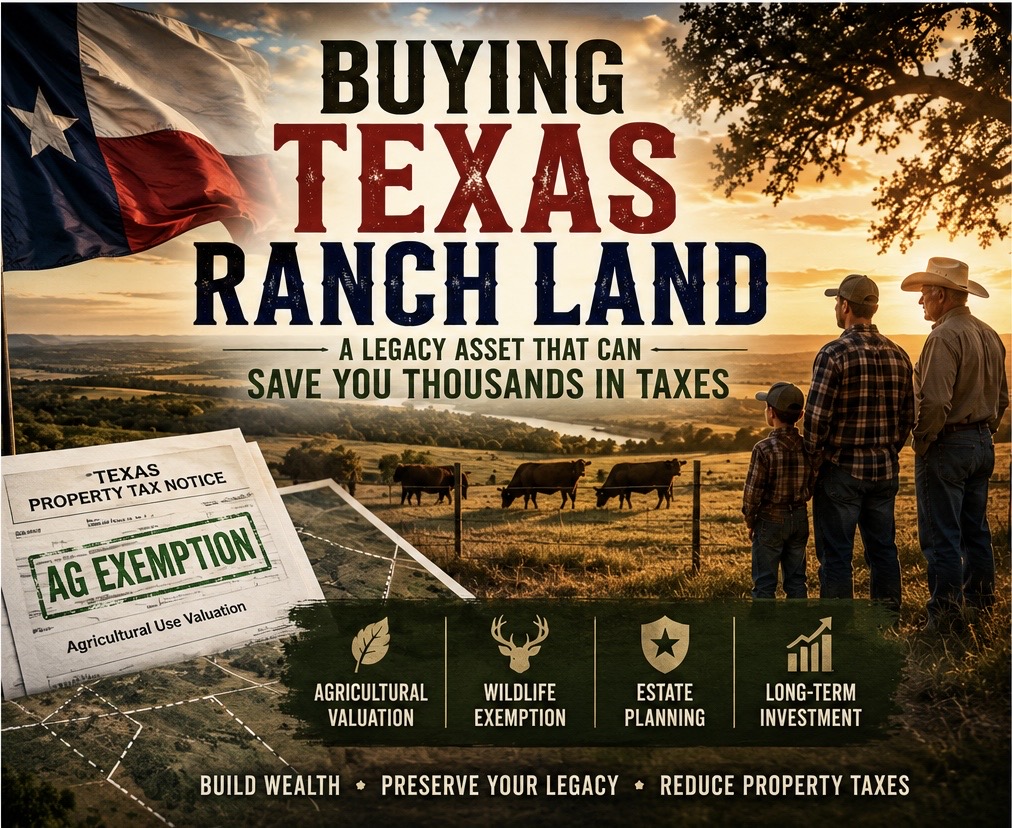
Here's where the Florida story undersells what's available closer to home. In most rural Texas counties, land that qualifies for an agricultural or wildlife management valuation isn't taxed on what a buyer would pay for it — it's taxed on what it produces.
Under Texas's 1-d-1 open-space appraisal, the county calculates property taxes using the land's agricultural productivity value rather than its market value. The gap between those two numbers can be dramatic. Texas Tax Experts, a Texas-based CPA firm, walks through two representative examples of just how wide that gap can run:
| Property Type |
Taxable Value (Market) |
Taxable Value (Ag Valuation) |
Estimated Annual Savings |
| 20-acre farm |
$500,000 |
$50,000 |
$7,200+ |
| 100-acre ranch |
$2,500,000 |
$250,000 |
$36,000+ |
The exact discount depends on the county and the land's classification, but paying tax on a fraction of market value instead of all of it is standard across rural Texas, and the gap widens further near the fast-growing corridors of North Texas, where market values are climbing fastest but ag-valued taxes barely move.
The Catch Nobody Puts in the Brochure
None of this is passive. To qualify, land generally has to have been devoted to agricultural use — running cattle, producing hay, wildlife management, beekeeping, or similar — for at least five of the preceding seven years, on a parcel large enough and worked intensively enough to meet the county's standard (commonly 10-plus acres with a minimum stocking rate, per Land Up Realty's overview of the exemption). That's not a box you check once at closing. It's an ongoing obligation the land has to keep meeting.
Let it lapse — sell off acreage for development, stop stocking cattle, let the exemption go inactive — and the county can claw it back. Rollback taxes require paying the difference between the ag-valued and market-valued tax bill for the prior five years, plus 7 percent interest for each of those years. On a property that's been saving $30,000 or more a year, that bill adds up fast.
It matters whether that person knows what a given county's appraisal district will and won't accept, knows what “the same intensity as is common in the area” means on the ground, and can tell you honestly whether a property's current use will survive the appraisal district's next review.
What's Happening to Values While All This Plays Out
While families work through the tax mechanics, the land itself keeps doing its job. According to the USDA's Economic Research Service, U.S. farm real estate values averaged $4,350 per acre in 2025, up 4.3 percent year over year (1.9 percent after adjusting for inflation). Pastureland specifically averaged $1,920 per acre, up 2.4 percent in real terms.
That's real, continued appreciation — but it's a noticeably calmer pace than the run the market saw earlier in the decade, when the five-year compound annual growth rate for U.S. farm real estate overall ran closer to 5.8 percent nominal (2.0 percent real) for 2019–2024. Notably, the Southern Plains region — which covers most of Texas and Oklahoma — posted the strongest inflation-adjusted growth of any region tracked in 2025, at 3.4 percent.
That combination — steady appreciation without the frenzy — is the window worth paying attention to. It's not a bubble, and it's not a reason to panic into a purchase. It's simply ground that keeps appreciating quietly while a family builds a life on it.
The Bottom Line
The “landmaxxing” trend making headlines out of Palm Beach and Miami Beach is really just a wealthy version of a much older idea: land is one of the few assets that can appreciate, produce income, shelter a family from taxes, and mean something to the next generation, all at the same time. In Texas and Oklahoma, the ag and wildlife exemption system makes that idea accessible to families well outside the billionaire bracket — provided the land is bought and worked correctly from day one.
GS Realty Team has helped families buy and sell more than 50,000 acres across Texas and Oklahoma. If you're weighing ranch land as part of a legacy plan — or want a straight answer on whether a specific property will actually qualify and hold its ag exemption — reach out. We know this ground. Let's find yours.
Ultra-Wealthy Buy Adjacent Lots in “Landmaxxing” Trend — The Real Deal — https://therealdeal.com/miami/2026/07/15/ultra-wealthy-buy-adjacent-lots-in-landmaxxing-trend/
Thinking About Buying a Ranch in Florida for Legacy? — Boca Raton Tribune — https://www.bocaratontribune.com/bocaratonnews/2026/07/thinking-about-buying-a-ranch-in-florida-for-legacy/
Texas Agricultural Exemption: How Farmers & Ranchers Can Save on Taxes — Texas Tax Experts — https://texasaccountant.us/tax/texas-agricultural-exemption/
What Is an Agricultural Exemption? — Land Up Realty + Investments — https://www.landuptexas.com/real-estate-blog/ag-exemptions
Land Use, Land Value & Tenure — Farmland Value — USDA Economic Research Service — https://www.ers.usda.gov/topics/farm-economy/land-use-land-value-tenure/farmland-value