
Published September 18, 2026
Screwworm Update: Why Three Is the Number That Matters

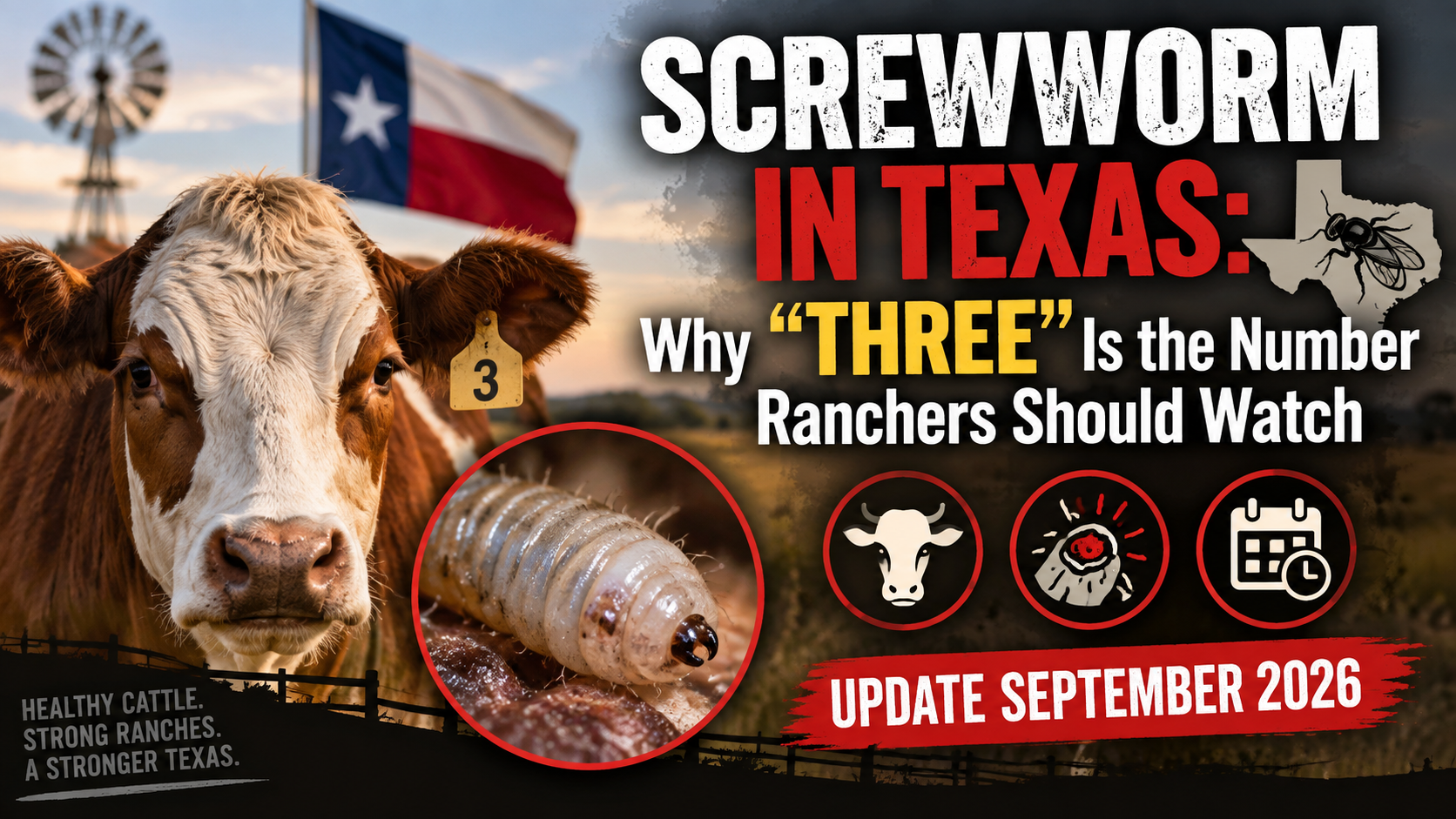
Screwworm in Texas: Why "Three" Is the Number Ranchers Should Watch
I've been tracking this outbreak since June, and for most of the summer the number that mattered was going the wrong direction.
Here's the one from this month. At a federal briefing on September 4, officials said that of 47 confirmed screwworm cases in the United States, just three remain active in Texas.
Three.
If you run cattle, keep horses, or own recreation acreage with a deer herd on it, that's the most important number you'll read this fall. It doesn't mean it's over. It means the line is holding — and it's worth understanding exactly why, because the "why" tells you what to do next.
Where this started
The New World screwworm is a parasitic fly whose larvae feed on living tissue. It infests livestock, wildlife, pets and, rarely, people. Left untreated, an infestation causes severe injury and often death. It is not a nuisance pest. It killed cattle by the millions in this country before we got rid of it.
Screwworm began moving north through Central America in 2023 and was confirmed in Mexico in November 2024, moving toward the border faster than anyone wanted. The first confirmed Texas case since the 1960s turned up in a calf in Zavala County on June 3, 2026. Over the following weeks cases spread across roughly 15 Texas counties — Zavala, Gillespie, Terrell, Sutton, Starr, Brewster and Andrews among them.
The response ramped hard and fast, and by early fall the active case count had dropped into the low single digits at any given time.
The trick: raise the flies yourself
The tool doing the heavy lifting here is the same one that worked sixty years ago, and it is one of the more elegant things American agriculture has ever pulled off.
You raise screwworm flies by the hundred million. You sterilize the males. You release them from aircraft over the affected country. Wild females mate once in their lives — that's the whole biology of it. If she mates with a sterile male, nothing hatches. Do that consistently over a wide enough area and the population collapses on itself without a drop of pesticide.
It's called the sterile insect technique, and it's why Florida was clear by 1958 and the United States declared itself screwworm free in 1966 after a program that pushed sterile flies out from a plant near Mission.
What's being built right now
Production capacity is the whole ballgame, and there's a lot more of it coming online than most people realize.
Sterile flies for this hemisphere have long come from the COPEG facility in Panama. USDA also invested $21 million to support Mexico's renovation of an existing fruit fly facility in Metapa, which roughly doubles production capacity, plus dispersal facilities in Tuxtla Gutiérrez and Tampico.
Closer to home: a sterile fly dispersal facility at Moore Air Base in Edinburg was completed in February 2026, about 20 miles north of the border, capable of dispersing 100 million sterile flies a week by ground and by air.
And a domestic production facility is under construction at the same site. At the September 4 briefing, USDA's senior adviser for screwworm preparedness said it will open April 1 — seven months ahead of schedule — and will gradually ramp to 100 million sterile flies per week over roughly six months.
That is a factory whose entire job is raising flies on purpose, in south Texas, so that the ones already out there can't reproduce. I have described this to about forty people since June and it never stops being funny. It is also, in plain terms, why the number is three instead of three hundred.
Why "eradicated" isn't a finish line
Here's the part I'd put in front of anyone who's ready to stop paying attention.
We declared the country screwworm free in 1966. Then Texas got hit again in 1976, and it was expensive. Reinvasion from Mexico happened periodically for years. The eradication line eventually got pushed all the way south to the Darién Gap between Panama and Colombia — and holding it there took constant work for decades.
Eradication has never meant "solved." It has meant "we're winning as long as we keep doing the work." Officials themselves have framed the current phase as making sure there isn't a recurrence.
So: good news, not finished news.
What you should actually do
Three practical things.
One — time your procedures. Every open wound is a door. Branding, castration, dehorning, ear tagging, docking, navel healing on newborns, foaling, difficult calvings, even barbed wire cuts and fresh brands on horses. If you can schedule a procedure for a lower-risk window, do it. If you can't, check the animal daily until it's closed.
Two — look, and look close. The thing you're watching for is a wound that isn't healing the way it should, an animal that's off by itself, head shaking, an odor, or an animal that won't leave a spot alone. Screwworm larvae burrow into living tissue, which is exactly what makes it different from ordinary blowfly strike. If something looks wrong, don't wait to see if it clears up. Report it.
Three — if you haul, check before you load. This is the one nobody in my roping circle has thought about. Movement restrictions apply in the infested zone counties, and if you're hauling animals out of one, there are inspection requirements. Ropers, barrel racers, cutters and anybody running the south Texas circuit needs to check current requirements before the trailer's hooked up, not at the checkpoint. Requirements change as zones change — screwworm.gov carries the current detection map and situation updates.
What it means for land
I write about land for a living, so let me close on that.
A screwworm outbreak hits ranch land value through three doors, and only one of them is obvious.
The obvious one is cattle. Sick cattle, restricted movement and added labor cost money, and a place that can't move stock freely is worth less to an operator.
The second is wildlife. This pest doesn't care whether an animal is in your herd or not. Deer are susceptible, and in this part of the world a hunting lease is real income and a real component of recreation acreage value. A significant wildlife impact would be felt in lease rates before it ever showed up in a sales comp.
The third is sentiment, and it's the sneaky one. Buyers price uncertainty. In the worst weeks of this summer I had people ask me whether they should wait to buy grassland in Texas. That question, multiplied across a market, is how a biological problem becomes a pricing problem.
Which is the real reason the number three matters. Texas rural land has stayed remarkably steady through this — statewide price per acre was still climbing year over year through the second quarter of 2026. The containment story is a big part of why. Buyers watched the state throw everything at this and hold the line, and they kept buying.
Keep checking your stock. Keep checking the map before you haul. And if you want to talk about what a place is actually worth right now — cattle, wildlife, water and all — call me.
I'm Greg Potts with GS Realty Team. 817-694-1339. We know this ground. Let's find yours.
Sources
- KBTX, "Federal officials say screwworm response is working, as new fly facilities near completion," Sept. 4, 2026 — https://www.kbtx.com/2026/09/04/federal-officials-say-screwworm-response-is-working-new-fly-facilities-near-completion/
- The Hill, "USDA speeds opening of Texas sterile fly facility amid screwworm outbreak," Aug. 11, 2026 — https://thehill.com/policy/healthcare/6022898-usda-texas-sterile-fly-facility-texas-spring-opening-screwworm/
- USDA APHIS, Sterile Fly Production and Dispersal Facilities — https://www.aphis.usda.gov/animals/animal-health/livestock-and-poultry-disease/sterile-fly-production-dispersal-facilities
- USDA press release, completion of sterile fly dispersal facility at Moore Air Base, Feb. 9, 2026 — https://www.usda.gov/about-usda/news/press-releases/2026/02/09/usda-announces-completion-sterile-fly-dispersal-facility-texas
- Texas Farm Bureau, "Sterile fly dispersal drives effort to stop NWS spread," June 9, 2026 — https://texasfarmbureau.org/sterile-fly-dispersal-drives-effort-to-stop-nws-spread/
- Landmark Wildlife, "Screwworm in Texas: 2026 Outbreak, History & Treatment" — https://landmarkwildlife.com/screwworm-is-back-in-texas-heres-what-you-need-to-know/
- Texas A&M Texas Real Estate Research Center, rural land price data
- Current detection map and reporting: screwworm.gov

Greg Potts
| Greg Potts | GS Realty Team | Fathom Realty
or another way